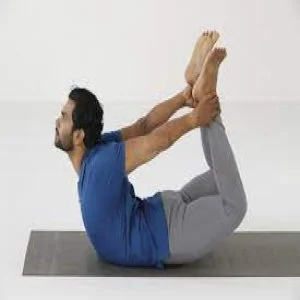
Dhanurasana (Bow Pose)
What Is Dhanurasana (Bow Pose)?
Dhanurasana, commonly known as Bow Pose, is a foundational backbend in yoga. Derived from the Sanskrit words “dhanu” meaning bow and “asana” meaning posture, this pose embodies the shape of a drawn bow, with the torso and legs forming the curved frame and the arms acting as the string.
One of the three essential back-stretching poses, this yoga pose encourages a strong stretch over the front of the body and a profound opening at the heart center, which will help you cultivate a graceful and confident mindset.
Dhanurasana gets its name from the bow-like shape the body adopts throughout the pose. A well-stretched body helps you maintain flexibility and proper posture, much like a well-strung bow is a warrior’s virtue.
The bow and Indian mythology
Indian mythology has made repeated recommendations for the bow. In the Ramayana, Lord Rama demonstrated his divinity by breaking Lord Shiva’s bow at Princess Sita’s swayamvara and winning the victory by marrying her. No other prince was able to accomplish this. Some of the most memorable dueling sequences in the Mahabharata featured the bow and arrow.
Both Prince Arjuna and his fiercest adversary, Karna, were proficient with bows and arrows. But Arjuna’s perseverance and constant practice made him superior to everyone else in archery. As you effortlessly transition into Dhanurasana, it is through this resolve and constancy that you will examine yourself.
Which muscles are used in Dhanurasana?
- Erector spinae
- Quadratus lumborum
- Rhomboids
- Trapezius
- Transverse abdominis
- Rectus abdominis
- Obliques
- Quadriceps
- Hamstrings
- Gluteus Maximus
- Biceps
- Triceps
- Deltoids
- Pectoralis major
- Latissimus dorsi
- Neck muscles
What are the Benefits of Dhanurasana (Bow Pose)?
- Hip flexors are strengthened.
- It stimulates the digestive system.
- Improves female menstrual health.
- Improves abdomen organs’ function.
- It helps to strengthen your upper back.
- Enhances standing and sitting posture.
- Provides therapeutic benefits to the brain.
- strengthens both the hamstrings and the spine.
What are the Preparatory poses for Dhanurasana?
These are the key preparatory poses that must be practiced before Dhanurasana.
- Shalabhasana (Locust Posture)
- Bhujangasana (Cobra Stretch)
- Setu Bandhasana
- Urdhva Mukha Svanasana
- Virasana
- Supta Virasana
- Sarvangasana
How to do Dhanurasana?
- Lay flat on your stomach.
- Ensure your legs are close together and your forehead is pressed against the floor.
- Bend your legs at the knees and raise your feet behind you.
- Gripping your ankles, lean your arms back.
- Take a breath. At the same time, raise your thighs and head off the ground.
- At this point, your body should be arching upward.
- Hold the position for ten seconds at the start.
- You can extend the timing to roughly one minute as you get more comfortable.
Dhanurasana (Bow Pose) Video:
What are Follow-up poses for Dhanurasana?
Practice these follow-up poses after doing Dhanurasana:
- Urdhva Dhanurasana
- Urdhva Mukha Svanasana
- Ustrasana
- Matsyasana
- Setu Bandha Sarvangasana
What are the Beginners’ Tips for Dhanurasana?
- To prevent your hip bones from rubbing on the floor, place a folded blanket beneath your pelvis.
- If you struggle to raise yourself off the ground, consider wearing a strap around your ankles.
- Try the pose gradually by keeping your knees and thighs on the floor and merely raising your torso.
- Before attempting this posture, make sure your spine is warmed up by performing lower backbends like locust and cobra.
What are the Types of Dhanurasana?
By itself, the Dhanurasana is a very contemporary pose. As you become more accustomed to the common bow posture, you can practice several versions of the Dhanurasana in addition to the common version. These are a few of the most popular varieties of Dhanurasana.
- Purna Dhanurasan
- Parsva Dhanurasana
- Urdhva Dhanurasana
- Dvpada dhanurasana or bridge bow pose
- Padagusta dhanurasana or big toe bow pose
- Dandayama dhanurasana or standing bow pose
- Eka pada Urdhva Dhanurasa (One-Legged Wheel Pose)
- Akarna Dhanurasana (Archer’s Yoga Pose)
Purna Dhanurasana
The Dhanurasana is a highly modern pose on its own. You can practice other variations of the Dhanurasana in addition to the standard one as you get more comfortable with the basic bow posture. These are some of the most well-liked Dhanurasana styles.
How to perform Parsva Dhanurasana ?
- On the mat, lie on your stomach.
- Raise your head by flexing your legs until the toes point in the direction of your head.
- Take a breath and use your hands to grasp your ankles.
- Lift your thighs off the ground, pull your arms, and raise your legs as far as you can.
- Take a deep breath and bring your shoulders forward.
- Draw your right shoulder toward the floor as you release your breath.
- Keep your eyes on your nose and hold yourself in a bow stance on the sides.
- Hold the posture for five breaths.
- Exhale, turn over on your stomach, and leap to the left.
- Repeat the same movements on the left after five breaths.
- At last, roll onto your stomach and return to the center.
- Relax into the prone position by letting go and straightening your legs.
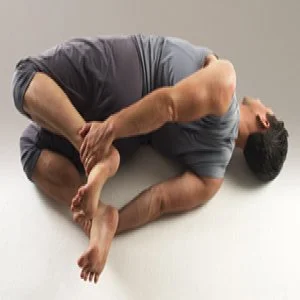
Urdhva Dhanurasana or upward-facing bow
What is Urdhva Dhanurasana?
Wheel position, also known as Full-Wheel Pose, Urdhva Dhanurasana, or Chakrasana, is a back-bending position that opens the chest, strengthens the arms, legs, and abdomen, and involves the entire body. This pose is a heart-opening stretch that helps people let go of their depression and sadness. In this exercise, you begin standing and bend backward until your palms contact the floor.
How to do Urdhva Dhanurasana?
- Place your feet parallel to your knees, which should be hip-distance apart, and lie on your back with your knees bent.
- Make sure your hands are by your ears, palms down, fingers pointing toward your shoulders.
- Breathe in, then exhale to raise yourself somewhat and place the top of your head on the mat without allowing your knees or feet to open apart. Avoid bearing any weight on your head.
- Pull your upper arms into their sockets, align your elbows with your midline, start arching your middle and upper back, and slide your elbows toward each other.
- With the next breath in, maintain all of these movements, then raise yourself into the pose by pressing down with your hands and feet.
- Keep your knees at least slightly bent while extending your arms as far as you can.
- Take care of your big toe piles and make sure your feet haven’t turned out.
- Move your tailbone toward your feet and the backs of your knees while rotating your inner thighs toward the floor. As you elevate your sternum in the direction you are facing and point your tailbone toward your feet, let your head dangle loosely.
- Walking your feet closer to your hands while keeping your shins and forearms parallel to one another and perpendicular to the ground will result in a deeper stretch.
- After a 5- to 10-breath pause, drop straight to the earth.
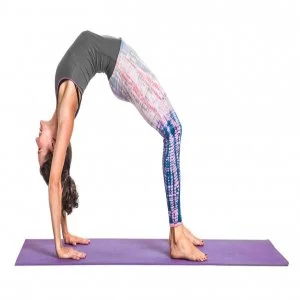
Dvpada dhanurasana or bridge bow pose
What is Dvapada Dhanurasana ?
Dvapada Dhanurasana is an Intermediate Level yoga pose. This is known as the Bridge Pose on the Elbow in English. The spine stays bent like a bow in this position. All of our bodily weight is supported by our elbows and feet. Two words are combined to form this stance.
Dvapada – bridge
Dhanurasana – Elbow pose
When we combine these words, a Bridge Pose on the Elbow is formed.
Meaning –
Hindi Means – Dwapada Dhanurasan
Sanskrit means – dvapada dhanurasana
English Means – Bridge Pose on Elbow
How to do Dvpada dhanurasana?
- First, you have to lie on your back on the mat.
- Your leg must now be bent using your knee. Your heels and hips should be nearby.
- You must now take a breath and raise your lower back.
- Make sure your shoulders and head are in contact with the mat.
- The lower back must be carried from the palms.
- From shoulder to elbow, your hands should make contact with the mat.
- It is now your responsibility to assume this role.
- You must breathe slowly and continuously during this.
- At last, you must let go of this position.
- At least 20 to 30 seconds must be held by the novice.
- The intermediate should hold more than 30 seconds but less than 60 seconds.
- The specialist will wait 120 seconds.
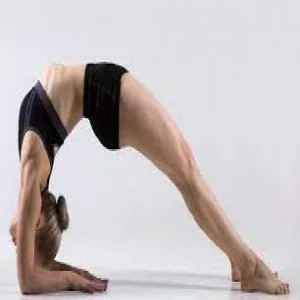
Padagusta Dhanurasana or big toe bow pose
What is Padagusta dhanurasana?
Big Toe Bow goes under several names, including Padangusthasana and Dhanurasana. This is a difficult pose, and if you want to practice it, you need a strong handstand. If you are not familiar with handstands, be sure to practice and develop a nice, stable handstand. The second requirement is a very excellent back bend.
If you lack this, practice using tools and poses such as Urdhva Dhanurasana (Upward Bow Pose) to strengthen and stabilize your spine before attempting. Your body simply won’t open if you press or tension too much in this pose, therefore the third item you need is a relieved mindset. You can begin as soon as you have these three items.
How to perform Big Toe Bow?
- Lay down, arms forward, and hands on the mat.
- Inhale, then jump with ease while lightly pressing your pelvic floor to regain your equilibrium.
- Breathe deeply a couple of times while maintaining the handstand.
- Exhale as you start to hollow your back after achieving a steady push-up from the shoulders.
- Maintaining leg extension, draw forward with the legs and press the shoulders. Once you’ve reached your maximum, softly flex your knee.
- Take some deep breaths while you’re in this position.
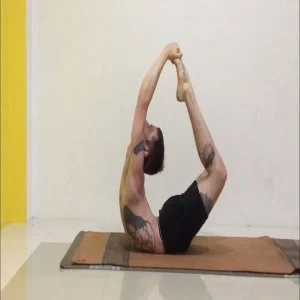
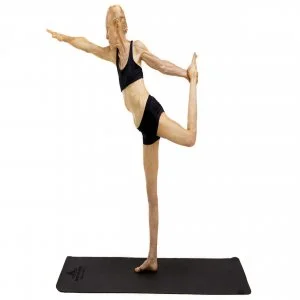
Dandayama dhanurasana or standing bow pose
What is Dandayama dhanurasana?
A contemporary form of standing balancing that incorporates a backbend is called Dandayamana Dhanurasana. The term derives from the Sanskrit words danda, which means “stick” or “staff,” Chandra, which means “bow,” and asana, which means “pose.”
Beginners benefit from the dandayamana dhanurasana, or standing bow-pulling pose. The Lord of the Dance Pose, sometimes referred to as the Standing Bow Pose is lovely and uplifting.
How to Do Standing Bow Pose?
- Place your feet together in Mountain Pose to begin.
- Draw your foot behind you and flex one leg while maintaining your knees together.
- With your hand straight out to your side and your elbow snug at your side, flex the same arm.
- Reach back and get hold of the inside of your foot with your fingers contacting the top and your thumb touching the sole.
- With your free hand extended forward, parallel to the floor, straighten your foot up and back.
- After a few moments of holding the pose, let go of your foot and stand up again. Instead of simply letting yourself slip out of the pose, try to release tension in a controlled way.
- On the other side, repeat.
Eka pada Urdhva Dhanurasa (One-Legged Wheel Pose)
What is Eka pada Urdhva Dhanurasa ?
Eka pada urdhva dhanurasana is another name for the one-legged wheel pose in Sanskrit. The one-leg-up modern bridge pose, a contemporary variation of the urdhva dhanurasana, improves spinal flexibility. It improves the respiratory system and reduces the accumulation of fat in your oblique areas. Osteoporosis can also be avoided with this pose.
How to do Eka pada Urdhva Dhanurasa?
- Start on your back with your knees bent, shins straight, toes looking forward, and feet hip-distance apart.
- To activate your hamstrings, lift your hips, tighten your inner thighs, and bring your heels close to your glutes.
- With your fingers facing the shoulders or slightly outward, bring your palms down close to your ears by drawing your arms up with them facing upward and flexing your elbows.
- Using your hands and feet, push up onto the top of your head.
- From here, straighten your arms and lift your head off the ground by pushing down once more.
- To shorten the pose, walk your feet in and squeeze your chest through the shoulder doorway.
- Pull your other leg into your chest with your toes pointing, draw one foot slightly closer to the center, balance on that foot, and then stretch your leg straight up.
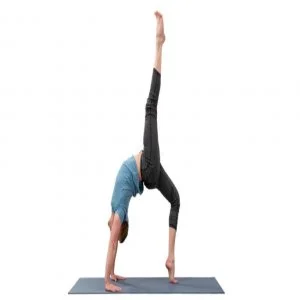
Akarna Dhanurasana (Archer’s Yoga Pose)
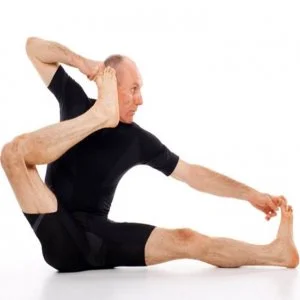
What is Akarna Dhanurasana ?
This amazing pose, known as Akarna Dhanurasana, is intermediate in difficulty and requires greater back power. The classic Dhanurasana is completely different from this pose.
The body adopts the shape of a bow in Dhanurasana, but in Akarna Dhanurasana, your body mimics aiming and stretching a bow’s strings. In contrast to Dhanurasana, Akarna Dhanurasana is a complex pose. This pose gets its name because your body assumes the shape of a bow and arrow in this pose.
How to do Akarna Dhanurasana?
- First, take a comfortable seat with your legs straight in front of you on the ground. Keep your shoulders, back, and head straight while doing this.
- Place your palms against your thighs and take a deep breath.
- Exhale now and move your left hand slowly in the direction of your left foot. With your left hand, grasp the big toe of your left foot and pull it toward your face. Try to reach your right foot’s big toe with your right hand during this, then grab and hold it there.
- Pull your left foot back from your face to your left ear while taking a deep breath.
- To return to your starting posture, exhale, remove your hands from your foot, and go slowly down your left leg.
- Repeat the same steps with your second leg.
What are the contraindications for a Dhanurasana?
- suffer from a weak heart
- high blood pressure
- hernia
- colitis
- peptic
- duodenal ulcers
- Migraine headache
- Injury to the neck
Conclusion
For yoga practitioners, there are numerous benefits to the bow posture. You can gradually incorporate the Dhanurasana and its various versions into your daily routine if you are just beginning your yoga practice.
FAQs
What is Dhanurasana and its benefits?
Bow Pose, also known as Dhanurasana, is a pose in which you lie on your stomach, raise your chest and legs, bend your knees, and pull your ankles. This pose helps digestion, increases energy levels, strengthens the back and core, and increases spinal flexibility.
Which disease is cured by Dhanurasana?
Dhanurasana benefits the digestive tract from a health perspective. Asthma and other respiratory issues are gradually relieved by the expansion of the chest during this pose.
Does Dhanurasana reduce belly fat?
After performing the Dhanurasana, your abdomen will appear incredibly toned. In addition to helping you stretch your arms, legs, back, abdomen, and chest, this pose also helps you straighten your posture. You should lie on the ground with your face down. Raise your legs and use both hands to grasp your feet.
When to avoid Dhanurasana?
Don’t do this if you have a weak heart, high blood pressure, a hernia, colitis, peptic ulcers, or duodenal ulcers. Because it activates the sympathetic nerve system and adrenal glands, this pose should not be performed right before bed.
Does Dhanurasana reduce breast size?
Another practice that requires bending the spine is Dhanurasana, often known as the Bow pose. It involves gripping your ankle with your hands and forming a U-shape while lying on your stomach. This stance lowers breast size because your chest is fully stretched out.
References:
- Dhanurasana – The Bow Pose | Steps | Benefits | Learn Yogasanas Online | Yoga and Kerala. (n.d.). Yoga. https://www.keralatourism.org/yoga/reclining-postures/dhanurasana
- Dhanurasana Yoga (Bow Pose) | Yoga Sequences, Benefits, Variations, and Sanskrit Pronunciation | Tummee.com. (2018, May 11). Tummee.com. https://www.tummee.com/yoga-poses/bow-pose
- EkhartYoga. (2021a, March 4). Bow Pose – Ekhart Yoga. Ekhart Yoga. https://www.ekhartyoga.com/resources/yoga-poses/bow-pose
- Shvasa Editorial Team. (2023, February 7). How To Practice Dhanurasana. https://www.shvasa.com/yoga-blog/how-to-practice-dhanurasana-bow-pose-steps
- Physiotherapist, N. P.-. (2024c, September 29). Dhanurasana: Health Benefits,variations and How to do ? Mobile Physiotherapy Clinic. https://mobilephysiotherapyclinic.in/dhanurasana-yoga-how-to-do/#What_are_the_Benefits_of_Dhanurasana_Bow_Pose
- Dhanurasana (Bow Pose). (n.d.). MyYogaTeacher. https://myyogateacher.com/yoga-asana/dhanurasana