
How Resistance Bands Help in Weight Loss and Rehab.
Resistance bands provide a low-impact yet highly effective way to build strength, improve muscle tone, and boost calorie burn—making them ideal for weight loss and rehabilitation.
Their controlled resistance helps activate muscles safely, enhances joint stability, and supports recovery without putting excess stress on the body.
What is resistance band exercise?
- Stretching rubber resistance bands takes the role of heavy workout equipment in resistance band training. Similar to utilizing machines or free weights, the power required to stretch the bands develops your muscles.
- Resistance bands, often known as exercise bands or fitness bands, are straightforward yet incredibly powerful instruments used in the fitness and rehabilitation sectors to increase mobility and strength. Usually composed of rubber or latex, they are available in a range of sizes, forms, and resistance levels.
- Unlike dumbbells, which maintain the same “resistance” or weight, these bands are engineered to provide more resistance when stretched to their maximum.
- Resistance bands were first created for use in physical therapy and rehabilitation settings, but over time, they have been widely used in fitness and weight reduction programs.
- The usefulness of resistance band exercises for weight reduction and how to use them safely for your fitness and weight loss objectives will be discussed in this article.
Types of Resistance Bands
There are several varieties of resistance bands, each with special benefits to suit a range of fitness requirements and skill levels.
A few popular varieties that you may use in your next workout are as follows:
- Loop bands: These are closed-loop bands that have the appearance of a big rubber band or a round loop. They are great for both upper-body and lower-body activities. Traveling with loop bands is easy, and they can be used anywhere.
- Tube bands (handles included): A tube with handles attached to both ends makes up a tube band. Bicep curls, chest presses, and rows are just a few of the workouts they work well for. Compared to other resistance bands, the handles offer a firm grip, which makes them simpler to use.
- Therapeutic flat bands: These bands have no loops or handles; they are broad, flat strips. Because they are adaptable, may be connected to form loops, and can be used for dynamic stretching, they are often used in physical therapy and rehabilitation activities.
- Figure 8 Bands: Figure 8 bands are ideal for upper body workouts, including front raises, lateral raises, and chest flies, since they resemble the number eight. Because of its special design, you may isolate and work certain muscle groups in your arms, shoulders, and upper back.
- Pull-Up assist bands: Pull-up and chin-up workouts are the main uses for these bands, which are stronger and thicker than other resistance bands. Additionally, you may stretch, squat, and execute deadlifts with these bigger resistance bands. When performing increasingly challenging exercises, such as pull-ups, these bands assist users in maintaining correct form while progressively increasing their strength.
Your exercise objectives, the muscle areas you wish to target, and your personal preferences will all influence the type of resistance band you choose. You may obtain a well-rounded fitness program that supports your goals, whether they be enhanced general fitness, weight reduction, or muscle growth, by including several types of resistance bands in your training routine.
Benefits of Resistance Bands
Resistance bands may be a useful addition to any fitness regimen, whether you’re a beginner trying to increase your strength or an expert athlete wanting to vary your routines. Here are a few major advantages:
- Portability: Resistance bands are an ideal option for individuals who want to work out at their home gym or while on the road because they are lightweight and portable. People may continue their exercise regimens while traveling or in confined locations since they are small enough to fit into a backpack or baggage.
- Affordability: An affordable substitute for physical exercise equipment is resistance bands. They accommodate different fitness levels and budgets by providing a range of resistance levels. For as low as $13, the majority are available in sets of three to five bands.
- Reduced risk of injury: Compared to high-impact exercises like jogging or plyometrics, resistance bands often offer a low-impact workout that is kinder to your muscles and joints. This feature makes them appropriate for people who are new to exercising, have joint problems, or are elderly.
- Flexibility: From simple muscle-building exercises like squats and bicep curls to more intricate routines like Pilates and yoga, these bands can be used for a variety of workouts. They enable users to develop a comprehensive exercise program by focusing on various muscle groups.
- Improved muscle engagement: Resistance bands are highly efficient in activating muscles across the whole range of action, despite their simplicity. They maximize muscle activation and development by creating tension during stretching and release.
Resistance Band Disadvantages
Resistance bands are a useful exercise aid, but it’s crucial to recognize their limitations and possible disadvantages:
- Bands may break: Over time, resistance bands can wear out or lose their elasticity, necessitating frequent replacement. Bands of poor quality are more likely to break and result in injury.
- Not the best for maximum strength: Resistance bands can help increase muscle and strength, but they might not be the greatest option for people who are just interested in bodybuilding or powerlifting, when the main objective is to lift very high weights.
- Curve of learning: When using resistance bands, proper form is crucial to preventing injuries. In order to complete exercises correctly, beginners may need assistance and practice. Maintaining appropriate alignment and tension during some motions can be difficult.
- Unmeasurable: It might be challenging to assess precisely how much weight you are using during an activity since a resistance band will alter its resistance as it stretches and relaxes.
For many people, resistance bands are nevertheless a useful and efficient exercise aid despite these possible drawbacks. They are useful for reaching a variety of fitness objectives, losing weight, and preserving general health and well-being because of their adaptability, affordability, and capacity to deliver an efficient full-body exercise while being easy on the joints.
Resistance Bands: How Effective Are They?
Resistance bands have gained popularity in the fitness industry because they are an efficient tool for encouraging muscle growth and weight loss. Resistance band use can aid in weight loss and muscle growth in the following ways:
- Calorie Burning: Exercises using resistance bands can raise your heart rate and burn more calories both during and after exercise. Even while they might not burn as many calories as high-intensity cardio workouts like jogging, they are still a good way to burn calories, especially when paired with cardio and other weight training exercises.
- Muscle Toning: Resistance band workouts work a variety of muscle groups, which helps to define and shape your body. An overall slimmer appearance is a result of toned muscles, which may be very inspiring for people trying to lose weight.
- A higher metabolism: When you use resistance bands to gain lean muscle mass, your resting metabolic rate automatically rises. This implies that even when you’re not exercising, you’ll burn more calories, which might help you lose weight by causing a calorie deficit.
- Full-Body Muscle Engagement: The majority of resistance band exercises often include more practical, full-body motions. This is a really quick approach to increase the amount of muscle in your entire body.
What happens if you are hurt? This can be quite difficult, particularly if it interferes with your fitness or weight loss objectives. Resistance bands, on the other hand, are an ideal tool for preserving fitness and minimizing muscle atrophy when wounded since they have been utilized in the rehabilitation context for many years.
Resistance bands minimize the chance of additional injury or suffering while providing a safe, regulated, and adaptable technique to preserve your fitness, aid in recovery, and stop muscle atrophy. Before beginning any fitness regimen while injured, speak with a medical expert, qualified personal trainer, or physical therapist to be sure the activities are suitable for your particular condition and recovery stage.
How Can Resistance Bands Be Used? This Are Our Advice
Resistance bands may be a safe and efficient approach to improve your exercise regimen, but it’s crucial to use the right form and take safety measures to reduce the chance of damage.
Here are some pointers on how to use resistance bands:
- Select the Right Band: Choose a resistance band with the right tension for the workout you want to do and your level of fitness. Usually, bands are available in several resistance levels.
- Start Slowly: When using resistance bands for the first time, start with a lesser resistance and progressively raise it as your strength increases. The band might break and injure you if you overstretch it.
- Correct Warm-Up: To get your muscles and joints ready for activity, start your workout with a thorough warm-up. To improve blood flow and flexibility, try low-intensity aerobic or dynamic stretches.
- Maintain Correct Form: When performing workouts, pay great attention to your form. To avoid injury, keep your posture correct, contract your core muscles, and make slow, controlled movements.
- Take Good Breaths: During your workouts, keep your breathing steady and under control. Avoid holding your breath, since this might result in lower oxygen flow and high blood pressure.
Try These Resistance Band Exercises
Try performing these muscle-burning exercises for two to three sets of eight to twelve repetitions, resting for thirty to sixty seconds in between each set and exercise. When beginning resistance-based exercise, use a lower resistance band, and as you gain strength, raise the band’s tension. For the best fitness and weight reduction outcomes, resistance-based exercise should be the main focus two to four days a week.
Squats:
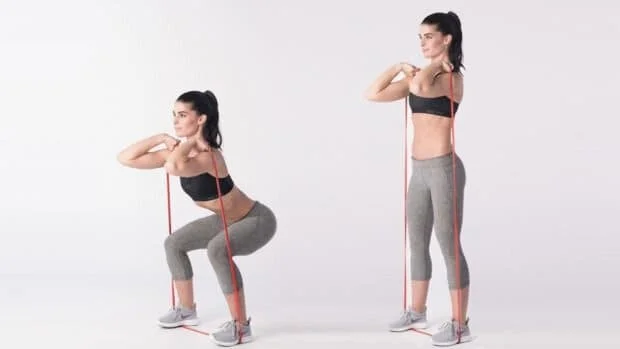
Place your feet hip-width apart and stand in the middle of a long resistance band. With your palms facing front, hold the band at shoulder height. Lower yourself into a squat by bending your knees, pushing your hips back, and bracing your core. Straighten your legs and stand back up by pushing through your heels.
Deadlifts:
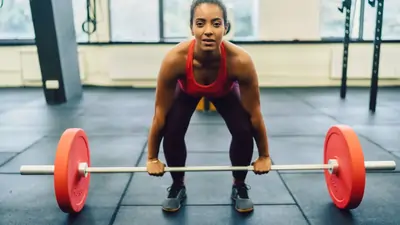
As with squats, begin in the same position. Start with a lot of stress on the band while holding it down by your hips. As you tilt at the waist while maintaining a neutral spine, brace your core and drive your hips back.
Your knees should be slightly bent, but the backs of your legs should still feel lengthy. When your torso is almost parallel to the floor, thrust your hips forward as you stand back up using your hamstrings and glutes.
Bicep curls:

Hold the lengthier resistance band with both hands, keeping your arms straight and palms facing up, while it is still beneath your feet. Bend your elbows to curl the band upward, keeping them close to your sides. At the peak of the exercise, squeeze your biceps, and then gradually return the band to your sides.
Standing Rows:
Secure an anchor at home or the gym, or fasten a longer band to a doorknob. With a medium level of tension on the band, stand far enough away from the anchor to begin with your arms fully extended. Pull the band toward your body with both hands while bending your elbows and pushing your shoulder blades together.
Your elbows should end just past your ribs and aim behind you. Extend your arms slowly and deliberately so that the resistance band returns to its initial length and your arms finish in the beginning position.
Chest Press:

Make sure there is sufficient tension in the band when your arms are fully extended by standing one to two feet away with your back to the anchor point and a longer band fastened to a solid anchor. Your hands should be at chest level, and your elbows should be bent at a 90-degree angle. Keeping your wrists straight, push both hands forward and away from your chest.
Without locking your elbows, fully extend your arms. As you press the handles forward, concentrate on contracting your chest muscles. Return to the beginning posture by slowly and deliberately bending your elbows to bring your hands back to chest level while resisting the resistance band’s pull.
FAQs
How does a resistance band help in weight loss?
By building muscle, resistance bands help you lose weight by raising your metabolism and burning more calories throughout the day. Additionally, they create small muscle tears that burn extra calories after recuperation (the “afterburn effect”) and generate a constant tension during exercises, increasing the amount of calories burned during exercise. This makes them useful for toning the body and losing weight when paired with other activities and a healthy diet.
Are resistance bands good for rehab?
With their many advantages that improve the healing process, resistance bands are useful instruments in physical therapy. They are perfect for a variety of therapeutic objectives because of their adaptability, progressive resistance, and joint-friendliness.
What are the disadvantages of resistance bands?
The main drawbacks of resistance bands are their limited maximum resistance for advanced lifters, inconsistent resistance (easier at the beginning, harder at the end of a movement), difficulty tracking precise progress, potential for tearing or snapping, and difficulties with specific exercises like deep squats or replicating the eccentric loading of weight training, which hinders muscle mass gains compared to free weights. Additionally, they may not be stable or comfortable to grip, and inexpensive bands could not be dependable.
What are common mistakes with resistance bands?
Excessive or insufficient resistance, improper anchor point setup, improper body alignment, etc.
Using momentum rather than control, overstretching the bands, and failing to inspect equipment for wear and tear.
References:
- Migala, J. (2024, January 30). Everything you need to know about resistance band workouts: what makes them effective, how to get started, and how to up the intensity. EverydayHealth.com. https://www.everydayhealth.com/fitness/resistance-band-workouts/guide/
- Dpt, S. Z. P. D. P., & Russin, H. (2023, September 21). How Effective are Resistance Band Workouts for Weight Loss? https://www.signos.com/blog/how-effective-are-resistance-band-workouts
- Clinic, C. (2022, May 4). How effective are resistance bands for strength training? Cleveland Clinic. https://health.clevelandclinic.org/should-you-try-resistance-bands-for-strength-training