V-Ups Exercise
What are V-Ups Exercise?
The V-up is a full-body core exercise that gets its name from the shape your body assumes during the exercise. Although you can choose to add weights to your V-ups routine, you can perform it anywhere with just your body weight and a little floor space. The most popular V-up forms are easy to learn how to perform. V-ups are excellent foundational exercises that improve your core and stability, which helps in lunging, jogging, and walking.
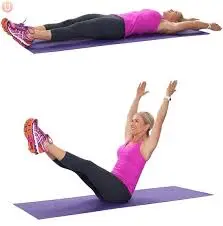
V-up exercises: What are they? The V-up is a core exercise that works the upper and lower abs. It involves using your core muscles to simultaneously raise your arms and legs off the ground. The letter “V” is how the proper V-ups form appears. You elevate your legs as though performing leg raises, and you raise your chest as though performing a sit-up.
Exercises involving v-ups can be performed with or without weights. They are important for developing core stability, which maintains the right alignment of your spine and pelvis. Additionally, a stronger core enhances stability, balance, and proper posture—all of which prevent lower back discomfort.
What Muscles Do V-Ups Work?
The lower body and core muscles are exercised during a V-up. The rectus abdominis and the oblique muscles are the main muscles used. V-ups also engage your quadriceps, adductors, and hip flexors because they require you to raise your legs off the ground.
Rectus abdominis: This muscle is situated between the pubic bone and the ribs in front of the pelvis. Its primary job is to transfer the body part between the pelvis and the ribs. People often call it the “six pack.”
External oblique muscles: On either side of the rectus abdominis are these muscles. They assist you with trunk twisting.
Internal oblique muscles: These muscles are found inside the hip bones and below the external oblique muscles. Although they function in the opposite direction from the external oblique muscles, they also help in twisting the trunk.
Hip flexors: The front of your upper thigh is home to this muscle group. To enable you to walk, run, sit, and stand, they cooperate to flex and stabilise your hip, thigh, and torso. They also help with knee flexion and hip rotation.
Adductors: Stretching from the pelvis to the femur, this muscle group is located in the middle part of your thigh. To maintain your balance when walking, they support pelvic stability and thigh movement.
Quadriceps: The front of your thigh is home to this muscle group. Their primary function is to assist with knee lifting . Additionally, they help in maintaining proper posture and balance, absorbing force during walking, and controlling gait.
How to Do V-Ups?
- To get the proper V-ups form, follow these steps:
- Stretch your arms above your head while lying on your back. Keep your feet together and your legs straight.
- Raise your feet about 6 inches off the ground by pointing your toes and using your core.
- Exhale as you use your core to raise your legs and torso simultaneously, forming a “V” with your body. Make sure your legs and arms are straight.
- Breathe in as you slowly lower your body to the floor while using your core. Make sure your legs are straight, and your arms are outstretched above your head. Your feet should be 6 inches above the ground.
- Try to complete 4 sets of 10–20 reps.
- Your level will determine how many sets and repetitions you need. Aim for four sets of five to eight repetitions for young people. Athletes at the intermediate level should strive for four sets of nine to nineteen repetitions. Target for four sets of twenty reps or more for more experienced athletes. For optimal results, perform this V-ups exercise three times each week.
V-Ups Exercise video:
V-Ups Adaptations:
For athletes of all skill levels and those with different levels of mobility, there are a number of V-ups modifications and substitutes, such as:
V-up alternative: For people who want additional upper body support, this is an improved version of the common V-up. Your knees must be bent, your feet must be firmly on the ground, and your arms must extend behind you, palms towards the floor. Maintain a straight back while pointing your fingers away from your body. With your upper body at a 45-degree angle to the floor, slowly fall back while using your core.
Bend your elbows and use them to support your torso as you’re leaning back. Take a breath out and raise one foot off the ground. For five to ten seconds, extend your leg straight out and point your toes away from your torso. Put your foot down slowly, then do the same with the other leg.
V-sit hold: The typical V-ups are static in nature. By sitting with your legs and torso in the air, you will retain the V shape for a longer amount of time rather than moving into it more frequently and holding it for shorter periods of time at the top.
Alternating V-ups: Except for switching between each leg as you reach up to produce the V shape, this exercise is similar to traditional V-ups.
Weighted V-ups: If bodyweight V-ups are too easy for you, you can use weights. Use ankle weights or the proper weight in your hands while performing the regular V-ups for this workout.
Make sure you have proper form and posture for each of these exercises. You’re either using too much weight or performing too many repetitions if your form is compromised.
Benefits of V-Ups:
Because there are so many variations, V-ups routines are accessible to athletes of all skill levels and can be performed practically anywhere. Other advantages of V-ups include:
Core strength: Because there are so many variations, V-ups routines are accessible to athletes of all skill levels and can be performed practically anywhere. Other advantages of V-ups include:
Improved balance and stability: To perform v-ups correctly, you must stabilise your adductors and core. This improves general balance by strengthening the stability muscles. Improved sports performance and fewer injuries are also linked to better balance and core stability.
Increased lower back health: A weak core raises the risk of injury by placing more strain on your back to support your torso. Your lower back will feel less strain if you strengthen your core.
V-Up Mistakes to Avoid:
Exercises using v-ups are generally safe and easy to practice. But if you perform them incorrectly for an extended length of time, you may wind up overstressing certain body components. When performing V-ups, it’s natural to arch or slump your lower back when you raise your torso off the ground. When lifting your torso, concentrate on activating your core muscles rather than your lower back.
Leaning back too far during the leg lift is not recommended for V-up variations such as the V-up alternative and V-sit hold. Maintaining your core muscles is the aim of the hold. Keep your torso up by using these muscles.
Lastly, pay close attention to any changes in your lower back and regulate the speed of your movements. For most of the moves, always use your core muscles to assist you.
Summary:
The V-up is a full-body core movement that simultaneously targets the upper and lower abdominal muscles. The goal is to lift your torso and legs off the floor at the same time, meeting in the middle to form the shape of the letter ‘V’.
It’s an advanced progression from standard crunches and sit-ups because it requires a high degree of core strength, balance, and coordination.
FAQ:
Are abdominal fats burned with V-ups?
No, belly fat won’t be reduced with V-ups. You must generate a calorie deficit in order to lose fat. Cardiovascular activity combined with a low-calorie diet is the most effective approach to achieve this.
How many V-ups per day?
Aim for four sets of five to eight repetitions for novices. Athletes at the intermediate level should strive for four sets of nine to nineteen repetitions. Aim for four sets of twenty reps or more for more experienced athletes. For optimal results, perform this V-ups exercise three times each week.
Is the 7-minute sit exercise effective?
You could achieve your finest physical condition ever with the help of the 7-Minute Workout. However, there is a cost: intensity! The program is only effective if you give it your all. Therefore, if you don’t currently exercise regularly, start by looking for a program that will help you get in shape.
V balance: what is it?
Lean backwards from a long sit position to place weight on your hands (place your hands behind your hips, rotating your fingers to point away) and raise your legs straight and tall. Remove your hands and hold your arms horizontally for balance on the bottom. Hold for three seconds.
Do V-UPS outperform situps?
This is due to the fact that v-ups are better at using all of your abdominal muscles, including your lower abs and obliques. However, he notes that while standard situps will engage your abs, they tend to focus more on your upper abs.
References:
- Ms E. Q. (2024b, August 16). How to do a V-Sit. Verywell Fit. https://www.verywellfit.com/v-sit-ab-exercise-3120059
- Stefanov, P. (2025, May 29). V Up: How-to, tips, variations, mistakes & Alternatives. Hevy – #1 Workout Tracker & Planner Gym Log App. https://www.hevyapp.com/exercises/how-to-v-up/
- Cpt, T. L. (2025, March 12). How to do V-Ups with proper form, according to a certified trainer. Women’s Health. https://www.womenshealthmag.com/fitness/a20698650/v-ups/