Fatty Liver
What is Fatty Liver?
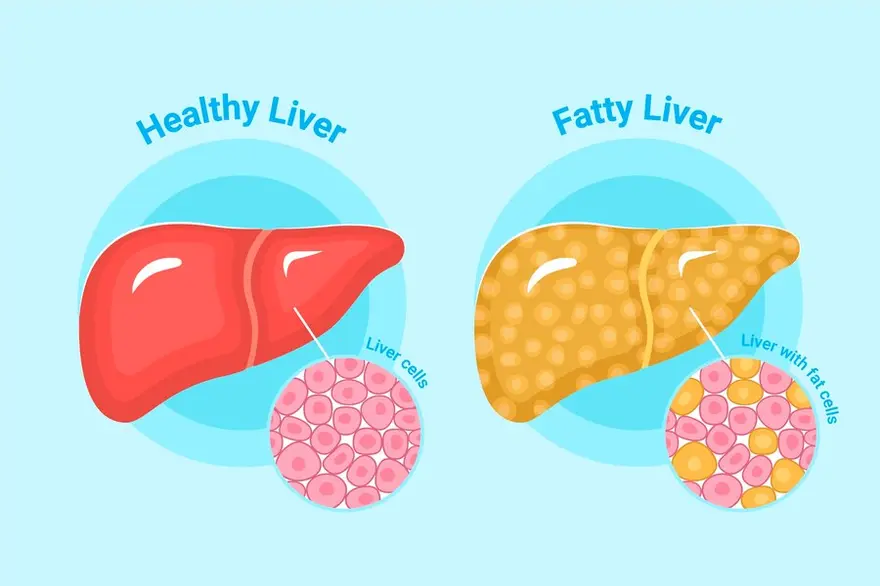
Fatty liver develops when an abnormal amount of fat accumulates within the liver cells. It is often linked to obesity, poor diet, diabetes, and unhealthy lifestyle habits. Early lifestyle changes, including a balanced diet, regular exercise, and weight management, can help improve liver health and prevent complications.
A healthy, well-functioning liver has a small amount of fat, but when that accumulation exceeds 5% of the liver’s weight, it becomes a problem. Steatotic liver disease (SLD) is a broad term that encompasses several liver conditions characterized by the accumulation of excess fat (steatosis) in the liver.
What led to the renaming of fatty liver disease as steatotic liver disease?
Steatotic liver disease was formerly referred to as “fatty liver disease.” To better reflect its causes, doctors renamed the illness and its subtypes in 2023. For instance, there are a number of risk factors that are not connected to weight or body mass index (BMI), even if some disorders, like obesity, that are linked to your body’s fat composition, can raise your chance of developing steatosis.
Additionally, language that can stigmatise people with SLD is avoided in the renaming.
Which forms of fatty liver disease are there?
Medical professionals categorise SLD according to its causes and related diseases.
Alcohol-related liver disease (ALD):
Fatty liver is caused by excessive alcohol usage in ALD. Your liver loses part of its cells every time it filters alcohol. There is typically no issue because your liver can produce new cells to replace the damaged ones. However, your liver might not be able to keep up if you consume excessive amounts of alcohol. Fatty liver may instead develop.
Metabolically associated fatty liver disease (MASLD):
Because the fatty liver isn’t linked to excessive alcohol usage, medical professionals used to refer to MASLD as non-alcohol-related fatty liver disease (NASLD). To better highlight the relationship between the accumulation of fat in your liver, experts termed the illness. It is cardiometabolic risk factors that cause MASLD. These elements include traits and circumstances that could endanger the health of your heart.
Risk factors associated with MASLD include:
- Obesity.
- Type 2 diabetes.
- High blood pressure.
- Irregularities of lipids, which are fatty substances present in cells.
Small weekly alcohol consumption is also associated with MASLD. For those who were assigned female at birth (AFAB), “small amounts” refers to less than 140 grams per week, and for those who were assigned male at birth (AMAB), less than 210 grams per week. For comparison, a typical 12-ounce beer in the United States has roughly 14 grams of alcohol.
Metabolically associated steatohepatitis (MASH):
One severe type of MASLD is metabolic-associated steatohepatitis (MASH). Fat accumulation in MASH leads to inflammation, tissue damage, and scarring (fibrosis). MASH was previously known as non-alcohol-related steatohepatitis (NASH) by medical professionals.
MASLD and increased alcohol intake (MetALD):
Alcohol use and metabolic risk factors both contribute to liver fat accumulation in people with MetALD. If you consume more than 140 grams per week (AFAB) or more than 210 grams per week (AMAB), you have a cardiometabolic risk factor for MetALD.
Depending on the individual, either metabolic risk factors or alcohol use are the main causes of liver fat accumulation.
Other forms of SLD:
Alcohol consumption and cardiometabolic risk factors are not the only causes of SLD. For instance, fatty liver can be caused by a number of illnesses and drugs. Healthcare professionals are occasionally unable to pinpoint a precise cause.
Is fatty liver disease a serious problem?
Usually, the accumulation of fat doesn’t lead to major issues or interfere with your liver’s usual operation.
Sometimes the illness develops into liver disease. Usually, it happens in phases:
Hepatitis: Your liver changes from being fatty to being enlarged and inflamed. Tissue is harmed by the inflammation. We refer to this stage as steatohepatitis. This is what occurs, for instance, when MASLD turns into MASH.
Fibrosis: Your liver stiffens as a result of the inflammation, forming bands of scar tissue. We refer to this process as fibrosis.
Cirrhosis: Healthy tissue is replaced by extensive scar tissue. You currently suffer from liver cirrhosis. Cirrhosis can result in potentially lethal diseases, including liver cancer and liver failure, if left untreated.
This is the reason it’s so critical to identify the cause of your liver’s fat accumulation and seek treatment. You can take precautions to keep your liver safe from additional harm, even if you have early-stage cirrhosis. By adhering to your provider’s recommended course of therapy, you may even be able to undo some of the harm.
Symptoms and Causes:
How does fatty liver disease manifest itself?
Symptoms of SLD are not always present. When they appear, symptoms consist of:
discomfort or a sensation of fullness in the upper right section of your abdomen.
severe weakness or tiredness (fatigue).
Usually, symptoms start to show up when liver cirrhosis has progressed from SLD. As cirrhosis progresses, you could encounter:
- Nausea.
- Loss of appetite.
- Unexplained weight loss.
- Skin and eye whites that are yellow (jaundice).
- Swelling in your abdomen (ascites)
- Bleeding in your stomach, rectum, or oesophagus that is discovered by your healthcare professional.
What causes fatty liver disease?
There are several causes of SLD. You are more likely to acquire SLD, though, if you have a cardiometabolic risk factor, consume excessive amounts of alcohol, or both.
Your risk of acquiring SLD is higher if you:
- Possess an alcohol consumption problem (heavy or frequent alcohol usage).
- Have metabolic syndrome, which is characterised by insulin resistance, high blood pressure, high cholesterol, and high triglyceride levels.
- Type 2 diabetes.
- Own a body mass index (BMI) of 25 to 29.9 kg/m2.
- Possess an obese BMI of 30 kg/m2 or above.
- Polycystic ovarian syndrome (PCOS).
- Obstructive sleep apnea.
- Possess low thyroid levels, or hypothyroidism.
- Possess low pituitary gland hormones, or hypopituitarism.
- Possess low sex hormones, or hypogonadism.
What are the complications of SLD?
If left untreated, a steatotic liver can develop into cirrhosis, which can result in liver failure, liver cancer, and extrahepatic malignancies. Heart disease is also more likely to strike those with MASLD. The primary cause of mortality for those with MASLD is heart disease, not liver disease.
Diagnosis and Tests:
How is fatty liver disease diagnosed?
Your healthcare practitioner can be the first to identify a problem because SLD typically doesn’t cause any symptoms. Elevated liver enzyme levels that appear on a blood test for another ailment could be cause for concern. A damaged liver is indicated by elevated liver enzymes.
In order to diagnose you, your healthcare provider might do:
A medical history that includes inquiries regarding your ailments, alcohol consumption, and medications.
A physical examination to look for indications of cirrhosis, such as jaundice, or inflammation, such as an enlarged liver.
Imaging tests, such as an MRI (magnetic resonance imaging), CT scan (computed tomography scan), or ultrasound, are used to look for indications of scarring and inflammation in your liver. To find out how much fat and scar tissue are in your liver, they could prescribe a specialised ultrasound called a FibroScan.
A tissue sample, or liver biopsy, is used to determine the extent of the liver illness. The sole method to differentiate MASLD from MASH is a liver biopsy.
A tissue sample, or liver biopsy, is used to determine the extent of the liver illness. The sole method to differentiate MASLD from MASH is a liver biopsy.
Management and Treatment:
How is fatty liver disease treated?
There’s no specific treatment or medication. Providers instead concentrate on assisting you in controlling the risk factors that lead to the illness. This includes changing your way of living to improve your health.
Your provider may recommend that you:
Avoid alcohol: Even if alcohol consumption has nothing to do with your SLD, avoid alcohol.
Lose weight: Weight loss can be aided by exercise, dietary changes (under a nutritionist’s supervision), and the use of drugs like GLP1RA. Bariatric surgery may be an option for you, and it can aid with weight loss.
Treat metabolic disorders with medication: Take your medications as directed to control blood fat (triglycerides), cholesterol, and diabetes. In certain situations, vitamin E and thiazolidinediones—drugs used to treat diabetes, like Actos and Avandia—may also be required.
Get vaccinated for hepatitis A and hepatitis B: If you already have liver disease, these viral infections might be particularly harmful.
If your medication is causing fat to build up in your liver, your doctor may decide to modify your prescription.
Prevention:
How can fatty liver disease be prevented?
Maintaining your general health is the greatest strategy to prevent SLD:
- Exercise regularly.
- Limit your alcohol consumption.
- Maintain a weight that’s healthy for you.
- Take your meds as prescribed if you have Type 2 diabetes or metabolic syndrome.
Summary:
Fatty liver disease causes the liver to accumulate excess fat. It’s a common condition, affecting about 25% of people in the United States.
FAQ:
Is fatty liver a serious problem?
A collection of disorders caused by an accumulation of fat in the liver are together referred to as non-alcoholic fatty liver disease (NAFLD). It is typically observed in fat or overweight individuals. In most cases, early-stage NAFLD is harmless, but if it worsens, it can result in severe liver damage, including cirrhosis.
Can someone with a fatty liver lead a normal life?
Will SLD kill you? Most people with SLD don’t have significant issues unless they get advanced cirrhosis. Life expectancy is typical for many people with SLD. Liver failure or liver cancer eventually results from untreated liver cirrhosis.
Can lemon remove fatty liver?
Although there isn’t a cure-all for fatty liver, adding hot lemon water to your routine could be beneficial. Although studies are still being conducted, certain possible advantages imply that it may help maintain the health of your liver. It does not, however, take the place of medical care or lifestyle modifications that your physician has prescribed.
What is a stage 1 fatty liver?
The hallmark of grade 1 fatty liver is the buildup of fat in the liver cells. With early intervention and lifestyle modifications, it is usually reversible. Alcohol usage, insulin resistance, poor diet, and obesity are among the factors.
What is a Stage 2 fatty liver?
Moderate fatty liver disease is known as grade 2. If an individual exhibits the following symptoms, they have grade 2 fatty liver disease: A deposit of fat in the liver cells is called steatosis. Hepatocyte ballooning. Hepatocytes are a subset of liver cells.
Is fatty liver 100% curable?
Exercise and weight loss are the primary treatments for fatty liver. Patients can reduce their liver’s fat, inflammation, and even scarring by losing weight. The objective is to exercise more than 200 minutes a week and reduce 7 to 10% of body weight annually.
References:
- Steatotic (Fatty) liver disease. (2025, February 11). Cleveland Clinic. https://my.clevelandclinic.org/health/diseases/15831-fatty-liver-disease
- National Library of Medicine. (n.d.). Fatty liver disease. MedlinePlus. https://medlineplus.gov/fattyliverdisease.html