Best Exercises for Knee Pain in Overweight People
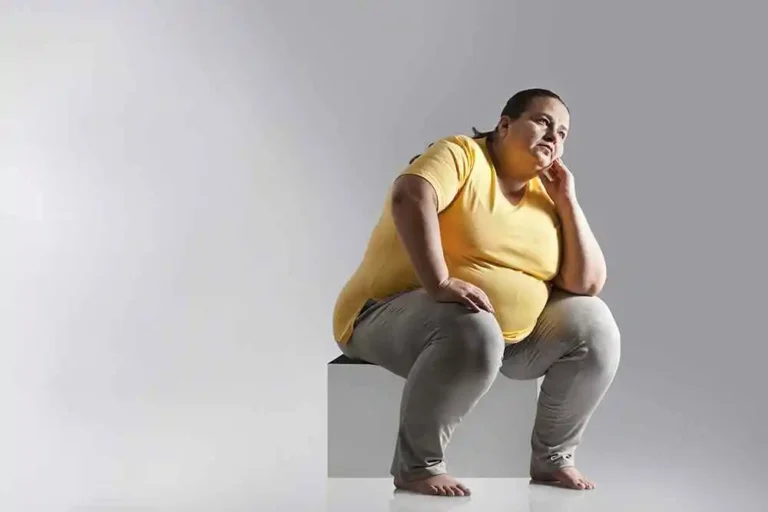
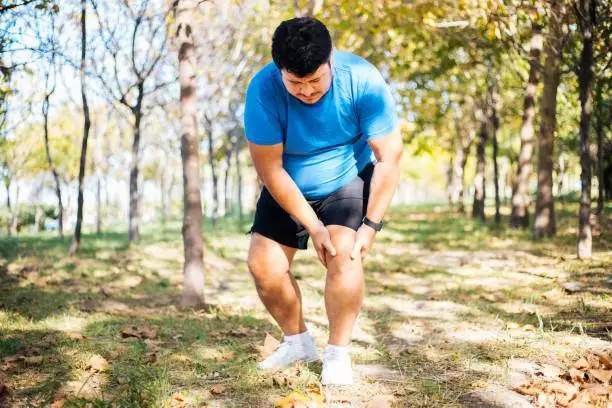
Knee pain is common among overweight individuals due to extra stress on the joints. Performing gentle, low-impact exercises can help strengthen the muscles around the knee, improve flexibility, and reduce pain effectively.
Introduction
Overweight-related knee pain is a major medical problem that impacts millions of people globally. Given the rising obesity rates, it is more important than ever to comprehend how being overweight affects knee health.
An excessive buildup of fat is a common sign of obesity, which can result in a number of health issues. Knee pain is one of the most prevalent and incapacitating of these. A complex joint made up of several bones, ligaments, and cartilage, the knee is especially susceptible to the strains that come with carrying extra weight.
Research on the interaction of mechanical stress on joints, fat-induced inflammation, and consequent cartilage degradation is expanding. The goal is to provide readers—whether they are medical professionals or people who are struggling with this problem—with useful information to properly address knee discomfort associated with being overweight by examining its causes, processes, and therapeutic techniques.
Knee Pain Causes
People of various ages and activity levels can have knee pain, which can have many different reasons. Selecting the appropriate activities to lessen knee pain requires an understanding of the underlying causes of knee pain. Knee pain is frequently caused by conditions including arthritis, trauma, or overuse. By determining the cause, knee strengthening exercises for knee pain can be used to target the precise areas that require rehabilitation or strengthening.
Effectively managing pain requires an understanding of the causes of knee joint pain, as well as prevention and treatment strategies. Ligament injuries, cartilage degradation, and chronic diseases like osteoarthritis are common causes. Physical therapy, strengthening exercises, medication, and lifestyle modifications are all possible forms of treatment.
The incidence of knee pain can be decreased, and general joint health can be enhanced by taking preventive steps such as keeping a healthy weight, wearing appropriate footwear, and participating in low-impact activities. Including knee strengthening exercises in your program can help promote long-term joint protection and mobility.
The following are a few typical reasons for knee pain:
- Arthritis: Rheumatoid arthritis and osteoarthritis are the two primary causes of knee pain, particularly in elderly individuals. Joint inflammation caused by arthritis leads to stiffness and pain.
- Injury: If left untreated, ligament tears, cartilage damage, or fractures sustained during sports can result in chronic knee discomfort.
- Overuse: Over time, repetitive activities like cycling or jogging can deteriorate the knee joint, resulting in persistent pain and swelling.
- Muscle Imbalance: Poor knee alignment can result from weak or tight muscles, especially in the thighs or hips, which puts additional strain on the joint.
- Obesity: Carrying too much weight strains the knees, causing pain and raising the risk of diseases like osteoarthritis.
The Benefits of Exercise for Knee Pain Relief
Not only is exercise safe for knee pain, but it’s also one of the greatest ways to relieve it.
Movement strengthens support muscles, aids with joint function, and speeds up recovery, according to scientific research.
It functions as follows:
- Enhances supportive muscles: Your glutes, hamstrings, and quadriceps lessen knee joint strain and absorb shock.
- Enhances joint lubrication: Your knee’s natural lubricant, synovial fluid, is circulated by gentle motion, which reduces stiffness.
- Enhances stability and alignment: Excessive friction is avoided, and improper kneecap tracking is corrected with balanced strength.
- Improves blood flow and flexibility: Movement and stretching increase muscular flexibility and circulation, resulting in more fluid movement.
- Encourages weight control: Each pound lost lowers around four pounds of knee strain.
Top Knee Pain Relief Exercises
Without the use of any equipment, these exercises increase flexibility, strengthen the knees, and stabilise the joints. Unless specified, complete two to three sets of ten to fifteen repetitions each. Work within a pain-free range at all times.
Straight Leg Raises

Why it functions:
Without forcing the knee to bend, this isolated exercise tones the quadriceps, the main muscle that stabilises and maintains the knee. It’s great for folks who have arthritis or stiffness after surgery.
Worked muscles: hip flexors and quadriceps
How to accomplish it:
- With one leg straight and one knee bent, lie flat on your back.
- Lift your straight leg slowly till it is 10 to 12 inches above the ground by tightening its thigh.
- Hold for two seconds, then slowly but steadily decrease.
Glute Bridge

The reasons it functions:
Decreases knee stress by transferring the strain from the front of your thighs to your posterior chain by using your glutes and hamstrings.
Muscles used: core, hamstrings, and glutes.
How to accomplish it:
- Lie on your back.
- Keep your feet hip-width apart while your knees are bent,
- Squeeze your glutes, lift your hips, and engage your core until your body is in a straight line from your shoulders to your knees.
- Hold for three seconds, then gradually release.
Wall Sit

Why it functions:
Ideal for people with sensitive knees, it increases the endurance of your quadriceps and glutes without requiring repetitive activity.
Quadriceps, glutes, and calves were the muscles used.
How to accomplish it:
- Place your feet shoulder-width apart and lean your back flat against a wall.
- Your knees should be at a 90° angle when you slide down the wall, or slightly higher if that is painful.
- Hold while maintaining an active core for 20 to 45 seconds.
Step-Ups (Low Surface)
Why it functions:
A practical, low-impact workout that replicates everyday tasks like ascending stairs and develops the legs proportionately.
Quadriceps, hamstrings, and glutes were exercised.
How to accomplish it:
- Make use of a low stair (4–6 inches in height), platform, or solid step.
- Using one leg, push through the heel to stand up straight.
- Repeat on the other leg after cautiously stepping down.
Side-Lying Leg Lifts
Why it functions:
Focuses on your hip stabilisers and outer thighs, which keep your knees from falling inward while you move.
Hip abductors and glute medius muscles were used.
How to accomplish it:
- Stretch and stack your legs while lying on your side.
- Raise your upper leg slowly to hip height while maintaining a straight posture.
- Pause, then carefully lower.
Calf Raises
Why it works:
It reduces unnecessary stress and knee misalignment by strengthening calves and enhancing ankle stability.
Calves’ soleus and gastrocnemius muscles were used.
How to accomplish it:
- Place your feet hip-width apart and stand tall.
- Get up on your balls, take a moment, and then slowly descend.
- Do 10–20 repetitions.
Seated Knee Extensions
Why it functions:
Promotes strength and joint stability without applying standing pressure by carefully targeting the quadriceps.
Quadriceps muscles were used.
How to accomplish it:
- With your feet flat and proper posture, take a seat.
- Tighten your thigh muscles as you slowly extend one leg forward until it is straight.
- Hold for two to three seconds, then slowly release.
Standing Hamstring Curls
Why it functions:
Balances the strength of the thigh’s front and back muscles, which is essential for proper knee mechanics.
Gluteus and hamstrings were used.
How to accomplish it:
- Hold a chair or wall for support while you stand erect.
- Bring your heel up to your glutes by bending one knee.
- Hold for a moment, then gently descend.
Mini Squats

Why it functions:
Ideal for early rehabilitation or sensitive knees, it increases lower-body strength and mobility without causing excessive knee flexion.
Quadriceps, hamstrings, and glutes were exercised.
How to accomplish it:
- Maintain a shoulder-width distance between your feet.
- As though you were lowering yourself into a chair, bend your knees slightly (15–30°).
- To get back up on your feet, push through your heels.
Clamshells

Why it functions:
Prevents knee valgus, which is the caving in of the knees during movement, by improving hip stability and alignment.
Hip rotators and glute medius muscles were used.
How to accomplish it:
- Knees bent at 45 degrees, lie on your side.
- Keep your feet together and raise your upper knee.
- Controllably lower slowly.
Quadriceps Stretch
Why it functions:
Releases tense quadriceps, which can cause pain or misalignment by pulling on the kneecap.
Worked muscles: hip flexors and quadriceps
How to accomplish it:
- Hold a chair or wall for support while you stand erect.
- Grab your ankle behind you and bend one knee.
- Gently tug until the front of your thigh feels stretched.
Hamstring Stretch
Why it functions:
Enhances knee range of motion and lessens strain by releasing tightness in the back of your thighs.
Hamstrings were the muscles used.
How to accomplish it:
- With one leg outstretched, sit on the floor.
- Maintaining a straight back, extend your hips forward toward your toes.
- For 20 to 30 seconds, hold.
Heel & Calf Stretch

Why it functions:
Helps you walk and track your knees properly by increasing the flexibility of your calves and Achilles tendon.
The Achilles tendon and calves were the muscles used.
How to accomplish it:
- Place one foot in front of you and one behind you as you face a wall.
- Lean forward and press your back heel down.
- For 20 to 30 seconds, hold.
Leg Slides
Why it functions:
Enhances circulation and knee mobility, making it ideal for post-sedentary stiffness or early recovery.
Worked muscles: hamstrings and quadriceps
How to accomplish it:
- Bend your knees and lie on your back.
- To make the leg nearly straight, slide one heel forward along the floor.
- Slowly return to the starting position.
Marching in Place

Why it functions:
Increases blood flow and joint lubrication while being impact-free, mildly strengthening the knees and hips.
Worked muscles: calves, quadriceps, and hips
How to accomplish it:
- Hold your arms at your sides in a comfortable position.
- In a marching rhythm, alternate raising your knees to your chest.
- Keep going for 30 to 60 seconds.
Walking
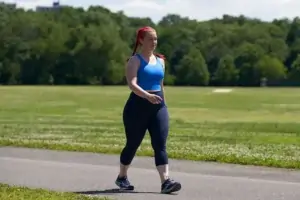
A straightforward walk is a fantastic low-impact aerobic activity that offers several health advantages. It is a good option for reducing knee discomfort because it is especially kind to the knees. Walking is a flexible and alluring activity for people of all fitness levels because of its accessibility and ease, as well as its beneficial effects on cardiovascular health and muscle power.
Avoid These Three Exercises If You Have Knee Pain
If you have aching knees, stay away from the following workouts regardless of your weight:
- Running
- Lunges
- Deep Squats
We are aware that exercising can be challenging if you have knee pain. Having said that, this knee brace is a cosy method to lessen knee pain, stiffness, and tension if you are overweight and would like to start exercising, but might use some additional support.
Precautions
Exercise is excellent for strengthening your knees and reducing pain, but it’s crucial to perform the exercises correctly to avoid inflicting more harm than good. Here are some guidelines:
- Observe the advice of your physical therapist and healthcare provider: Based on your diagnosis, they will be able to tell you which exercises are specifically helpful for your knee pain and which are not.
- Pay attention to your body: Any exercises that worsen the pain should be stopped.
- Keep an eye on your form: If done incorrectly, any workout might worsen knee discomfort over time.
- Stay away from workouts that overextend or strain the knees too much: Running, lunges, and deep squats are probably not the best exercises.
- Put on the appropriate footwear: Maintain the condition of your training shoes. Over time, worn shoes lose their ability to provide enough support, which can worsen knee pain. Those who exercise for 30 minutes a day should, on average, get new shoes every six months. However, wear occurs more quickly the heavier you are. To distribute the wear over a longer time frame, you can think about alternating between two or more pairs of shoes.
- Before working out, warm up: By raising your body temperature and encouraging blood flow, a warm-up helps your muscles relax. Because it gets the joints ready for exercise-related activities, warming up is also beneficial to the joints.
FAQs
Which workouts are best for those who are overweight and have knee problems?
To increase strength and lessen joint stress, overweight people with knee pain should concentrate on low-impact activities, including walking, cycling, swimming, and water aerobics. When done slowly and with assistance, mild strength and flexibility exercises like calf rises, modified squats, straight leg raises, and targeted stretches like the hamstring and quadriceps stretch can also be helpful.
Will losing weight help with my knee pain?
Bone can rub against bone in the absence of this cushion. That could result in pain and oedema. Being overweight may worsen the symptoms. To lessen the symptoms of knee arthritis, experts typically recommend that persons who are overweight or obese lose at least 10% of their body weight.
Which workout is the most effective for knee pain?
For those with knee problems, water aerobics is a great form of exercise. In addition to being one of the best cardiovascular exercises for the whole body, water aerobics also relieves joint stress.
How may overweight-related knee pain be treated?
Focus on losing weight through exercise and a nutritious diet to alleviate knee discomfort caused by being overweight, because this lessens the strain on the joints. R.I.C.E. (rest, ice, compression, elevation), the use of braces or canes, over-the-counter anti-inflammatory drugs, and mild workouts like swimming or stretching are other instant relief techniques.
When knee pain occurs, which exercise should be avoided?
Seven Activities to Stay Away From If You Have Knee Pain:
Squats.
Lunges.
Extending the legs.
Interval training at a high intensity.
Exercises involving jumping.
Climbing stairs.
Extremely strenuous sports.
Reference
- Exercise for overweight or obese people with knee pain – MANADr Medical Notes – ManaDr. (n.d.). https://manadr.com/articles/exercise-for-overweight-or-obese-people-with-knee-pain
- Ningthoujam, N. (2024, December 8). 11 knee-friendly weight loss exercises to keep obesity at bay. Healthshots. https://www.healthshots.com/fitness/weight-loss/knee-friendly-weight-loss-exercises/
- Saishreepune. (2025, September 2). 5 Exercises for Overweight Knee Pain. SaiShree Hospital. https://www.saishreehospital.org/5-exercise-for-over-weight-knee-pain/
- Llewellyn, J. (2021, November 22). Are You Overweight with Knee Pain? Learn These 7 Easy Exercises Even Obese People Can Do. BraceAbility. https://www.braceability.com/blogs/articles/exercises-for-overweight-knee-pain